Introduction
A newly described fossil from southeastern China suggests that some early bird relatives may have followed a very different route. The species, named Yuezhuornis Yangyuanensis, lived during the Late Jurassic, approximately 150 million years ago. Published in Nature on 14 October 2026, it provides new evidence about the variety of animals that existed during the early stages of bird evolution because fossils from this period are relatively rare, each new discovery can help scientists test and refine their understanding of how early birds lived and diversified.
Scientific Background
Modern birds belong to a larger evolutionary group known as Avialae, which includes extinct relatives of today's birds. These evolved from feathered dinosaurs and developed changes in their skeletons and limbs over time. Flight played an important role in this history, but it may not explain every aspect of early bird diversity. Scientists use fossils to reconstruct the lives of animals that disappeared millions of years ago. By examining the shape and proportions of bones and comparing them with those of other extinct animals and living birds, researchers can investigate how an animal might have moved and interacted with its environment.
What Scientists Discovered / Experimental Results
Researchers identified Yuezhuornis Yangyuanensis from a fossil found in the Zhenghe region of Fujian Province, southeastern China. Its skeleton contains a combination of features associated with early birds and other dinosaur groups. The relatively short forelimbs of Yuezhuornis, along with its unusual second toe and other anatomical features, led researchers to investigate whether it was better adapted to moving on the ground. The fossil's features suggest that early bird evolution was more varied than a simple progression toward flight might imply.
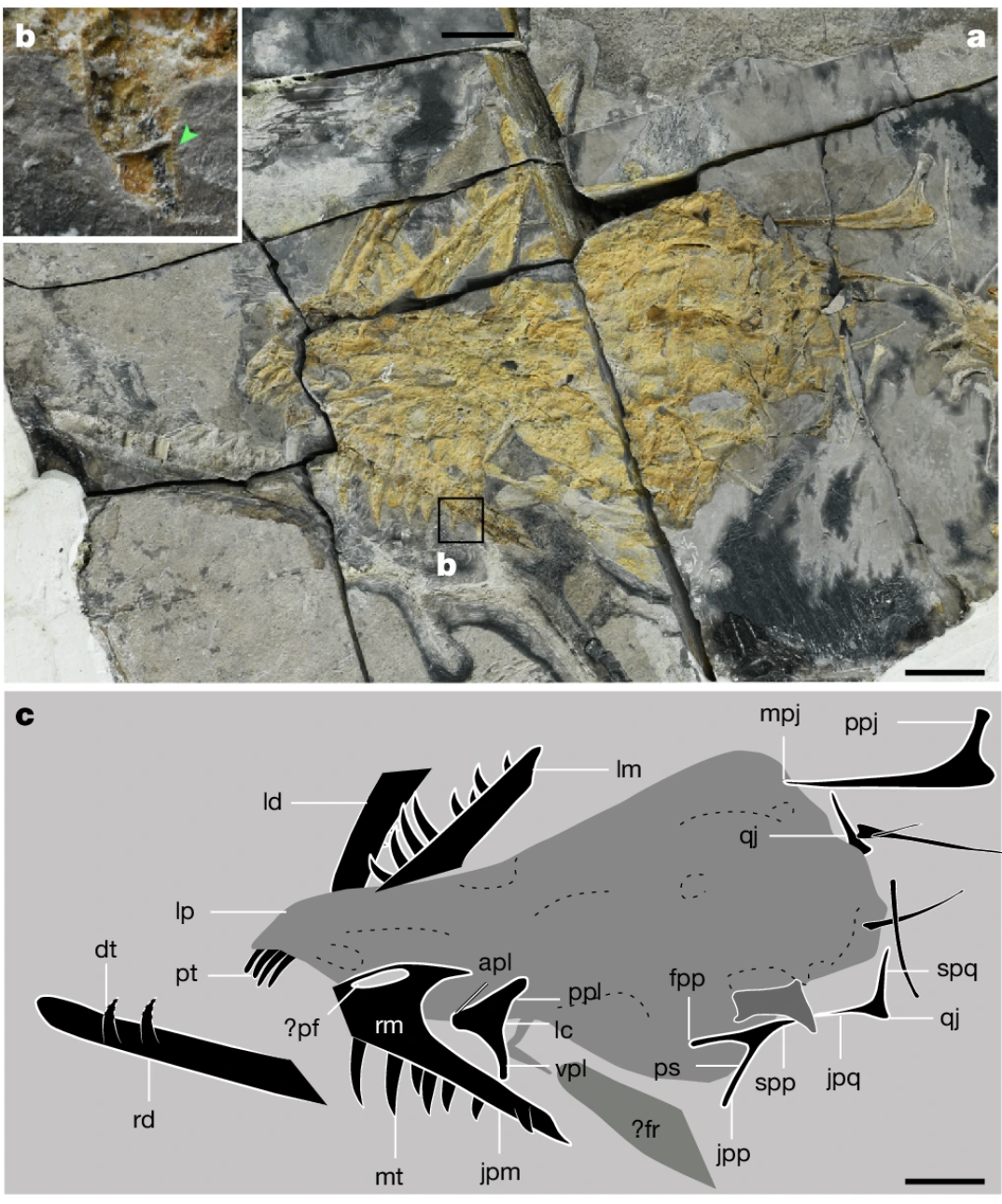
Fig. 2 a–c, Photographs (a,b) and line drawing (c) of the skull of Y. yangyuanensis, showing the serrated maxillary teeth (arrowhead in b (inset in a) indicates serrations on the distal margin).
Why This Discovery Matters
The discovery of Yuezhuornis Yangyuanensis is significant because it expands our understanding of the ecological diversity of early bird relatives. Also, the fossil demonstrates why new discoveries can change scientific understanding. Scientists build explanations from the evidence at a particular time, but they can be more detailed as new fossils are found. Yuezhuornis offers another example of how the evolutionary history of birds may have included unexpected branches and lifestyles.
Limitations and Next Steps
Fossils preserve physical structures, not the complete behaviour of an animal, so it can’t answer every question about their daily life, such as its diet, movement, and ecological role. Additional fossils could help researchers clarify the evolutionary relationships between Yuezhuornis and other Jurassic animals. Future discoveries may strengthen the current interpretation or reveal new details about how this animal lived
BioSTEM Breakthrough’s Takeaway
The discovery of Yuezhuornis Yangyuanensis shows that evolution does not need to follow more than one path. This Jurassic animal appears to have been adapted to life on the ground, showing that early bird relatives may have explored different ecological paths rather than developing toward powered flight in the same way. I found this interesting because future fossil discoveries could help scientists better understand how these early birds diversified.
Source
Xu, L., Wang, M., Lin, G. et al. Jurassic flightless bird reveals early ecological diversity of avialans. Nature 658, 690–697 (2026). https://doi.org/10.1038/s41586-026-10972-z