Potential supplement that could fight cancer?
Introduction
Cancer cells can sometimes evade detection by our immune system. Scientists are currently studying whether arginine, an amino acid that supports many essential functions throughout our bodies every day, could help the immune system recognize cancer cells.
Scientific Background
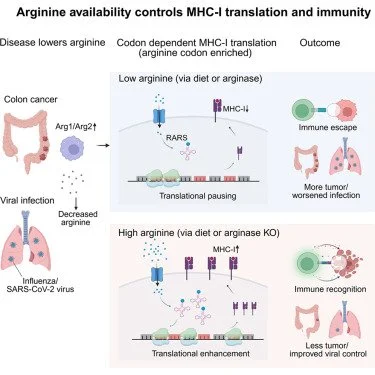
MHC-1 is a protein that is on your cells’ surface throughout the human body. It helps T-cells identify and destroy cancer cells. T-cells are a type of white blood cell that coordinates the immune system to attack cancer cells.
What Scientists Discovered / Experimental Results
Qiushuang Wu, PhD and their team’s work at Rockefeller University studied tumor development in mice that were fed a diet that contained different levels of arginine. They discovered a inverse relationship between the amount of arginine in the mice’s diet and the amount of tumors that develop in the colon of those mice. Mice with lower arginine levels had more tumors develop in the colon and vice versa. These findings suggest that arginine may increase the signals for immune cells to recognize cancerous cells.
Why this discovery matters
This discovery may help scientists develop better ways to improve cancer immunotherapy, which can decrease the number of deaths per year. Even if this can’t cure cancer. It can make patients live a longer and much happier life.
Limitations and next steps
Currently, scientists are still testing this new supplement since there were no human clinical trials and were only tested on mice. This will need human clinical trials to determine whether the supplement is safe and effective for us. Also we don’t know the long term affect of eating a diet that has high amounts of arginine on mice.
BioSTEM Breakthrough’s Takeaway
I found this interesting because it shows that nutrition and the immune system are related in our body. Cancer is a very complex disease for us to solve, and having these tests done on animals could be an important step for us to develop new treatments.
Source
Wu Q, Seydlitz LM, Iakimov V, Hsu DJ, Habibzadeh P, Hoffmann HH, Paty PB, Rice CM, Tavazoie SF. Dietary arginine drives codon-dependent MHC class I translation and improves immunity in colon tumorigenesis and respiratory viral infection. Cell. 2026 Jul 30:S0092-8674(26)00818-4. doi: 10.1016/j.cell.2026.07.020. Epub ahead of print. PMID: 42532044.
